







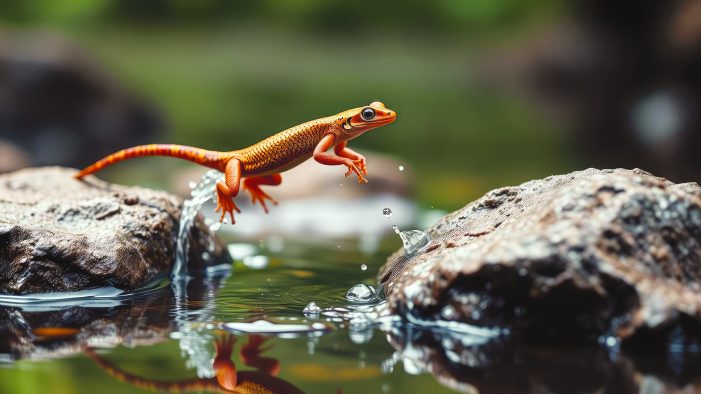
(August 25, 2026) I met a frog up close and personal the other night.
After the hot day, I went outside to check on a newly potted plant, but it was too dark to distinguish its black soil from the color-adaptable creature that had bedded down for the evening. I didn’t scream when my index finger poked the squashy frog, which answered by leaping from the pot. I’m improving.
I’ve been under the influence of a good book, Pilgrim at Tinker Creek, which is Annie Dillard’s 1974 memoir of a year spent exploring her local habitat. Though initially uninterested in this nature topic, I wanted to know how she earned a Pulitzer Prize by writing about a creek and the life it supports—tadpoles, salamanders, muskrats, etc. I soon realized the author, besides her uniquely descriptive style, wrote with passion for her subject. She hadn’t lost the wonder of it all.
I last held a snake as a child at my back-patio birthday party. A neighbor walked over to surprise us with a large but harmless black snake, and none of my grade-school friends fled the scene.
Children tend to view creeping things with proper amazement. At wildlife centers, they’ll pet a ball python or let a tarantula crawl up their sleeves. But we grow up and then, like someone who lives with an ocean view, we forget to be amazed.
“Never lose a holy curiosity,” Einstein said, and Dillard agrees. Most of us won’t use a microscope beyond high-school biology class, but she keeps one handy. In a single drop of pond water, she observes otherwise invisible lifeforms such as rotifers, daphnia, and copepods. She wants us to know, “These are real creatures with real organs leading real lives.”
The author’s deep dive into the study of nature includes spiritual questions. The word Pilgrim in her title suggests the journey of discovery goes beyond wild and wet things. Rightly overwhelmed by the intricate designs she observes in all created things, she wonders about the necessary “creator” behind it all, using the small letter “c,” due to her uncertainties. She realizes, however, that God is too infinite to fit under any microscope.
“No one can fathom what God has done from beginning to end,” wrote the wisest king, Solomon (Ecclesiastes 3:11 NIV). Though we perceive his divine nature and power through creation (Romans 1:20), admiring God’s works falls short of knowing him. The apostle Paul warned against always learning but never arriving at the truth (2 Timothy 3:7).
We can observe the contours and colors of the Grand Canyon from a sightseeing flight. But hiking to the bottom is a real experience. Though the topside tourist marvels over the canyon, the hiker experiences it; he knows, loves, and fears the canyon, having gained a true understanding of its awesome size and character.
Those who attempt to discover God only through study and contemplation will find the dive is too deep. “Such knowledge is too wonderful for me; … I cannot attain it” (Psalm 139:6*).
Finding God will require letting go of our own ideas about him. Once we accept what God says about himself, we advance from divine wonder to calling him wonderful.
John’s Gospel says, “In the beginning was the Word, and the Word was with God, and the Word was God…. All things were made through him, … And the Word became flesh and dwelt among us, … the only Son from the Father, full of grace and truth” (John 1:1, 2, 14*).
Through Jesus Christ, God reveals himself—up close and personal.
*ESV
 Faith Columnist Patti Richter writes and edits Christian faith articles and has co-authored Signs of His Presence: Experiencing God’s Comfort in Times of Suffering.
Read more of her essays at BlueRibbonNews.com.

Patti Richter On Faith | Beyond the Microscope: From Wonder to Wonderful added by Editor on
View all posts by Editor →